

|
|
|
|

































| All Things Christmas | |
| Biblical Christmas | |
|
|
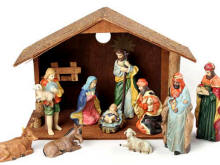
From the Old English 'Cristes Mæsse' ~ meaning the 'mass of Christ' ~ the story of Christmas begins with the birth of a babe in Bethlehem. It is believed that Christ was born on the 25th, although the exact month is unknown. December was likely chosen so the Catholic Church could compete with rival pagan rituals held at that time of year and because of its closeness with the winter solstice in the Northern hemisphere, a traditional time of celebration among many ancient cultures. |
|
Biblical Christmas Luke, Chapter Two |
|
|
And it came to pass in those days, that there
went out a decree from Caesar Augustus, that all the world should be
taxed. (And this taxing was first made when Cyrenius was governor of
Syria.) And all went to be taxed, every one into his own city. And
Joseph also went up from Galilee, out of the city of Nazareth, into
Judaea, unto the city of David, which is called Bethlehem; (because
he was of the house and lineage of David:) To be taxed with Mary his
espoused wife, being great with child. And so it was, that, while
they were there, the days were accomplished that she should be
delivered. And she brought forth her firstborn son, and wrapped him
in swaddling clothes, and laid him in a manger; because there was no
room for them in the inn. And there were in the same country shepherds abiding in the field, keeping watch over their flock by night. And, lo, the angel of the Lord came upon them, and the glory of the Lord shone round about them: and they were sore afraid. And the angel said unto them, "Fear not: for, behold, I bring you good tidings of great joy, which shall be to all people. For unto you is born this day in the city of David a Savior, which is Christ the Lord. And this shall be a sign unto you; Ye shall find the babe wrapped in swaddling clothes, lying in a manger." And suddenly there was with the angel a multitude of the heavenly host praising God, and saying, "Glory to God in the highest, and on earth peace, good will toward men." |
|
|
|
|
| Candy Canes | |
|
|
It was not long after Europeans began using Christmas trees that special decorations were used to adorn them. Food items, such as candies and cookies, were used predominately and straight white candy sticks were one of the confections used as ornamentation. Legend has it that during the 17th century, craftsmen created the white sticks of candy in the shape of shepherds' crooks at the suggestion of the choirmaster at the Cologne Cathedral in Germany. The candy treats were given to children to keep them quiet during ceremonies at the living crèche, or Nativity scene, and the custom of passing out the candy crooks at such ceremonies soon spread throughout Europe. |
|
According to the National
Confectioner's Association, in 1847 German immigrant August Imgard
used the candy cane to decorate a Christmas tree in Wooster, Ohio.
More than 50 years later, Bob McCormack of Albany, Georgia
supposedly made candy canes as treats for family, friends and local
shopkeepers. McCormack's brother-in-law, Catholic priest Gregory
Keller, invented a machine in the 1950s that automated the
production of candy canes, thus eliminating the usual laborious
process of creating the treats and the popularity of the candy cane
grew. |
|
|
|
|
| Cards | |
|
|
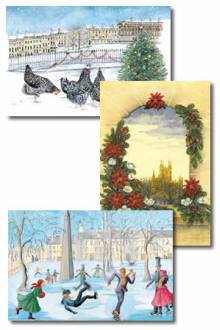
A form of Christmas card began in England first when young boys practiced their writing skills by creating Christmas greetings for their parents, but it is Sir Henry Cole who is credited with creating the first real Christmas card. The first director of London's Victoria and Albert Museum, Sir Henry found himself too busy in the Christmas season of 1843 to compose individual Christmas greetings for his friends. He commissioned artist John Calcott Horsley for the illustration. The card featured three panels, with the center panel depicting a family enjoying Christmas festivities and the card was inscribed with the message "A Merry Christmas and a Happy New Year to You." Read more about Christmas Cards |
|
|
|
|
|
In Northern Europe Christmas
occurred during the middle of winter, when ghosts and demons could
be heard howling in the winter winds. Boughs of holly, believed to
have magical powers since they remained green through the harsh
winter, were often placed over the doors of homes to drive evil
away. Greenery was also brought indoors to freshen the air and
brighten the mood during the long, dreary winter. |
|
|
|
| Mistletoe | |
|
|
Mistletoe was used by Druid priests
200 years before the birth of Christ in their winter celebrations.
They revered the plant since it had no roots yet remained green
during the cold months of winter. |
|
|
|
| Poinsettias | |
|
|
A native Mexican plant, poinsettias were named after Joel R. Poinsett, U.S. ambassador to Mexico who brought the plant to America in 1828. Poinsettias were likely used by Mexican Franciscans in their 17th century Christmas celebrations. One legend has it that a young Mexican boy, on his way to visit the village Nativity scene, realized he had no gift for the Christ child. He gathered pretty green branches from along the road and brought them to the church. Though the other children mocked him, when the leaves were laid at the manger, a beautiful star-shaped flower appeared on each branch. The bright red petals, often mistaken for flowers, are actually the upper leaves of the plant. |
|
|
|
| Rudolph the Red-nosed Reindeer | |
|
|
The Chicago-based Montgomery
Ward company, department store operators, had been purchasing and
distributing children's coloring books as Christmas gifts for their
customers for several years. In 1939, Montgomery Ward tapped one of
their own employees to create a book for them, thus saving money.
34-year old copywriter Robert L. May wrote the story of Rudolph the
Red-nosed Reindeer in 1939, and 2.4 million copies were handed out
that year. Despite the wartime paper shortage, over 6 million copies
had been distributed by 1946. |
|
Writing in verse as a series of rhyming
couplets, May tested the story as he went along on his 4-year old
daughter Barbara, who loved the story
Sadly, Robert Mays wife died around the time
he was creating Rudolph, leaving Mays deeply in debt due to medical
bills. However, he was able to persuade Sewell Avery, Montgomery
Ward's corporate president, to turn the copyright over to him in
January 1947, thus ensuring May's financial security. |
|
|
|
|
| Santa Claus | |
|
|
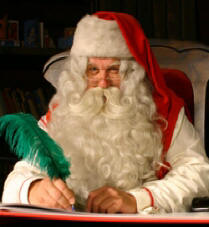
The origin of Santa Claus begins in the 4th century with Saint Nicholas, Bishop of Myra, an area in present day Turkey. By all accounts St. Nicholas was a generous man, particularly devoted to children. After his death around 340 A.D. he was buried in Myra, but in 1087 Italian sailors purportedly stole his remains and removed them to Bari, Italy, greatly increasing St. Nicholas' popularity throughout Europe. His kindness and reputation for generosity gave rise to claims he that he could perform miracles and devotion to him increased. St. Nicholas became the patron saint of Russia, where he was known by his red cape, flowing white beard, and bishop's mitre. |
|
In Greece, he is the patron saint of sailors,
in France he was the patron of lawyers, and in Belgium the patron of
children and travellers. Thousands of churches across Europe were
dedicated to him and some time around the 12th century an official
church holiday was created in his honor. The Feast of St. Nicholas
was celebrated December 6 and the day was marked by gift-giving and
charity. After the Reformation, European followers of St. Nicholas dwindled, but the legend was kept alive in Holland where the Dutch spelling of his name Sint Nikolaas was eventually transformed to Sinterklaas. Dutch children would leave their wooden shoes by the fireplace, and Sinterklaas would reward good children by placing treats in their shoes. Dutch colonists brought brought this tradition with them to America in the 17th century and here the Anglican name of Santa Claus emerged. In 1822 Clement C. Moore composed the poem A Visit From Saint Nicholas, published as The Night Before Christmas as a gift for his children. In it, he portrays Santa Claus:
He had a broad
face and a little round belly, Other countries feature different gift-bearers for the Christmas or Advent season: La Befana in Italy ~ The Three Kings in Spain, Puerto Rico, and Mexico ~ Christkindl or the Christ Child in Switzerland and Austria ~ Father Christmas in England ~ and Pere Noël, Father Christmas or the Christ Child in France. Still, the figure of Santa Claus as a jolly, benevolent, plump man in a red suit described in Moore's poem remains with us today and is recognized by children and adults alike around the world. Read even more about Christmas traditions and Santa Claus |
|
|
|
|
| Stockings | |
|
|
According to legend,
a kindly nobleman grew despondent over the death of his beloved wife
and foolishly squandered his fortune. This left his three young
daughters without dowries and thus facing a life of spinsterhood. |
|
|
|
| The variations of the Christmas traditions of USA equal the number active cultures that have settled in the land. These cultural contributions were given a new lease of life by creative artists, authors, poets and songwriters, and it was melded together by the power of secular and commercialized media in record companies, radio stations, television, cinemas and now the internet. The unwritten law of media is the presentation of a seemingly uniform celebration of the Christmas traditions of USA. This is responsible for the world wide acceptance of a universal Christmas image which they get from the media. Nevertheless, the celebrations are peculiar to each region. | |
|
|
|
| Trees | |
|
|
In
16th-century Germany fir trees were decorated, both indoors
and out, with apples, roses, gilded candies, and colored paper. In
the Middle Ages, a popular religious play depicted the story of Adam
and Eve's expulsion from the Garden of Eden. A fir tree hung with apples was used to symbolize the Garden of Eden and was called the Paradise Tree. The play ended with the prophecy of a savior coming, and so was often performed during the Advent season. It is held that Protestant reformer Martin Luther first adorned trees with light. While coming home one December evening, the beauty of the stars shining through the branches of a fir inspired him to recreate the effect by placing candles on the branches of a small fir tree inside his home |
|
The Christmas Tree was brought to England by Queen Victoria's husband, Prince Albert from his native Germany. The famous Illustrated News etching in 1848, featuring the Royal Family of Victoria, Albert and their children gathered around a Christmas tree in Windsor Castle, popularized the tree throughout Victorian England. Brought to America by the Pennsylvania Germans, the Christmas tree became by the late 19th century. Read even more about Christmas Trees |
|
|
|
|








|
Pound High School 11531 Wildcat Drive Pound, Virginia 24279 Tel. No. (276)796-4432 Fax No. (276)796-5983 Wise County Schools, Wise, VA 24293 Copyright © 2001-2010 Pound High School All rights reserved Revised: Tuesday, May 24, 2011 |
|
In addition to valuable educational resources, the Internet also contains inappropriate content. When students are exploring web sites on the Internet, Teachers and/or Parents should supervise them. WCPS and PHS are not responsible for the content of external web sites linked from WCPS or the PHS website. This web site was designed by Denise Gabriele. This web site it maintained by Denise and Frank Gabriele. |